Report of round 9
Levon Aronian took an important leap ahead in his neck-and-neck race with Norways Magnus Carlsen for the 10,000-euro first prize in Grandmaster Group A at the 74th annual Tata Steel Tournament. In what may turn out to be the decisive encounter of the 13-round chess spectacular, the Armenian defeated Italys Fabiano Caruana (see picture), while Carlsen went down against Sergei Karjakin of the Ukraine in ninth-round play on Tuesday.
I managed to get my opponent into my preparation, Aronian explained, and I obtained a very good position. It looked like it was going to be a comfortable win. But then, for some reason or other, I started to complicate things with each and every move I made. Im not sure where my opponent made his final mistake but I certainly know where I made my mistakes. Even so, Aronian the second highest ranked player in the world- did not have too much trouble winning after finding himself a rook up halfway through the encounter. I might have finished it in a simpler manner, he complained, but youre bound to make mistakes in such a long tournament.
The victory, in 47 moves from a rare line of the English opening, not only put Aronian one point ahead of Carlsen and two other competitors but also earned him a 500-euro bonus, as GM Ivan Sokolov decided to pick this game for the daily Piet Zwart Prize, put up by the municipalities of Velsen and Beverwijk. Aronian, Sokolov said, came up with an interesting plan in the opening, gaining huge compensation for the pawn sacrifice (see diagram) 9.0-0, and followed it up with
entertaining play. Caruana missed his final chance to salvage a draw as late as his 39th move, where he should have tried (see diagram) 39
Nxg4, but the unusual material balance made it a hard for over-the-board play.
It is a pity, Sokolov added, that Aronian continues to complain about his bad play after every round. It is not true to begin with and, moreover, its not good for himself, for the tournament and for his opponents.
Karjakins victory over Carlsen (see picture), in 60 moves with black from a Queens Indian Defense, did not qualify for the prize, Sokolov said, criticizing the Ukranian for allowing white an extra tempo in the opening and Carlsen the worlds highest ranked grandmaster for blundering in an equal position. Karjakin admitted Carlsen had lent a helping hand but was far from dissatisfied with his own performance.
18.Ne4 was not the best, he told reporters after discussing the game with Carlsen. Magnus could have kept the balance with 18.Nb5 and 23.Qd2? wasnt good either. 23.Qg4 would have been the lesser evil, just as 25.b3, where he played 25.Rb1? I might have decided it faster with 26 g6 27.Bxd3 Ne4 28.Bxe4 Dxd2 29.Rxd2 Rxd2 but thought that wasnt clear enough and went 26 Rd5. The bare fact that that proved to be winning too, was an indication of how good his position was, he said.(see video of the press conference at Tata Steel Chess facebook)
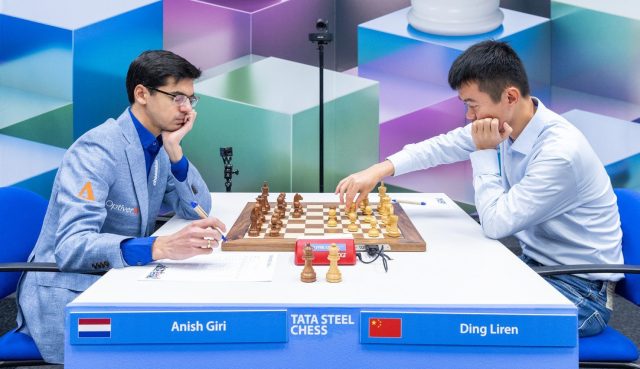
Dutch champion Anish Giri disappointed his fans sorely, following up his dismal failure in the previous round with another loss in Tuesdays action. Playing black in a Queens Gambit against Vassili Ivanchuk of the Ukraine, the 17-year-old grandmaster came under heavy pressure but fought back valiantly until he caved in at his 47th, where he failed to include whites strong (see diagram) 52.f4! in his calculations. He was forced to resign ten moves later.
The other games of the round were all drawn, with Hollands Loek van Wely and World Championship Challenger Boris Gelfand the first to leave the tournament arena after a mere 19 moves from a Nimzo Indian Defense. It was Lucky Loeks ninth draw in as many rounds, making him the uncrowned drawing king of the tournament; no other players in groups A, B and C managed an uninterrupted series of draws.
Hikaru Nakamura of the U.S. and Bulgarias Veselin Topalov (see picture) put up more of a fight, going at one another in an English game in good-old coffee-house style. Despite no end of wild play and difficult complications, however, the balance was never
really disturbed and a draw was agreed after 37 moves. What an incredible mess, Topalov said afterwards, discussing the game with Van Wely, a former second. I thought I was better, or was I? Somehow, I played (see diagram) 20
b5 and then,
it wasnt so clear, or was it? And I went (see diagram) 22
Nd7, incredible, isnt it? I guess I almost blundered. As Nakamura left for his hotel room immediately after signing his score sheet, the Bulgarian did not get a chance to analyze the encounter, as was clear from his comments.
U.S. champion Gata Kamsky and Teymour Radjabov (see picture) played a quiet Ruy Lopez that ended in a correct draw after 55 moves, but the same could not be said of the outcome of the encounter between Radjabovs fellow Azeri Vugar Gashimov and David Navara of
the Czech Republic. On the contrary: Gashimov profited from a blunder by Navara at the 23rd to gain the upper hand, only to miss (see diagram) 25
Rxc7! which would have won after 25...Qxc7 26.Qg5 Rg6 27.Qxg6. Gashimovs 25.g4? more or less restored the balance and although the game continued to the time control, the result was never in doubt.
The 250-euro daily prize in Group B went to Cubas Lazaro Bruzon for his win with black in 31 moves from a Bogo-Indian Defense against Russias Vladimir Potkin (see picture), who fell a victim to the weakness of the white squares on his kingside.
Indias Pentala Harikrishna kept the lead in this section of the tournament after a quick win in 28 moves with black in a Queens Gambit against Ilya Nyzhnyk of the Ukraine. The Indian GM is one point ahead of his nearest rivals in Group B.
Hollands Anne Haast collected the 100 euros set aside for the day prize in Group C. The 18-year-old WIM (Womens International Master) defeated the much higher rated Sahaj Grover of India in 39 moves with white in a Winawer French.
Swedens Hans Tikkanen and Russias Maxim Turov both won their games to remain tied for first place in this group. In the same group, Holland's Lisa Schut achieved her first WGM norm after drawing her game against England's Matthew Sadler.